Choose a Better Kitchen Culture

What makes a kitchen a place that we want to spend our time? What makes us stay? We all have felt the pressure, worked the long hours. Know the results of physical labor on our bodies. Learned how to tolerate the verbal and physical abuse.  We understand that stress to make the restaurant and only the restaurant your life’s priority.  The damage done to your body, usually with no or little health care included.  What makes us spend our days in a place like that?

While I’ve heard and even myself answered this question in multiple ways, I’m going to change my patented answer and say something a little (okay a lot) crazy that might surprise you. Or, maybe not, considering the source.  Don’t. Don’t stay in a place that’s abusive, that’s not supportive of your growth and your sustained inclusion as part of the staff.

I’ve experienced the kind of work place that treats commis and cdps like toilet paper. Turn and burn through them like you would a guest at a ‘fast casual’ joint.  Get what you can out of them, see who sticks it out, see who falls apart, and move on to the next warm body who shows up at the back door.  I’ve gritted my teeth and worked my way up despite the expectation that I would fail.  To be real, in some of those places, I learned a lot. Who I am as a cook today started in those kitchens. The skin I have has been hardened and burned by what I learned to let flow off of my back.  There were also several jobs where I could add very little to no new skills after a stint of excessive verbal abuse. Just flat out wasn’t worth it. In one or two, I wasn’t even comfortable putting them on my resume, I despised their treatment of people so much.  It’s a crapshoot sometimes, which is why gaining experience at more than one place was valuable for me. I learned that not every job is the same, that I can expect better for myself and for others.

While it may be tempting to bear through it for the boost of a famous name on a resume or for the kind of training and pressure that can hone one (like a diamond, no?) into a better cook; fine. Bear it if must. Just don’t stay too long or drink that second helping of Koolaid.   (And make sure when it’s time to leave, it’s in a gracious way that’s not going to ruin all of that hard work. Read: give appropriate notice).  And once you’re out, remember a couple of things:

  • 1. Having a social life outside of work can create or re-enforce perspectives that are valuable.  You are less likely to forget why eating out is enjoyable in the first place if you don’t let yourself fall into the tunnel vision of being an insider.  [Yes, you and your fellow industry friend are the only people at the table annoyed that the restaurant copy of the check is not on top, no one else noticed, get over it].
  • 2. Other creative outlets or pursuits do not take away from ones ability to create in a kitchen. In fact, for me, having other passions and activities helps my creativity become a stronger muscle when I can flex it in multiple capacities.  I can be a photographer and a writer and a vocalist and and… without being any less of a cook.
  • 3. When you run yourself ragged, and do not nourish your body, it does not help your performance at work.  Rest days are important.  I’m guessing that all of the hard work being put into a cooking career isn’t just so you can turn around and open a yoga studio in a few years.  If you don’t rest and rejuvenate your body and your mind- it increases the risk of burnout.  To make it the long haul, we are all going to have to start treating ourselves like athletes who are running a marathon rather than a sprint.  Exercise, rest, food, mental health care, dental care, medical care etc will have to become priorities. [Ugh, it all sounds so gross and responsible.] For real though, take care of yourself, so that you have the ability to take care of others.  Also, you and I both know that kitchens are dangerous places full of hot and sharp and heavy things.  Injury increases when you are not well rested and not thinking clearly. This includes the infamous hangover [sorry guys]. Try and keep the partying to the non-school nights, maybe?

And here I’ll add a little bit of the party back in, while tying in to #1 and #3: vacations are not something to feel guilty about.  Use them as part of your toolbox for creating a varied perspective and a well balanced human.

Very Importantly:

  • 4. Fear does not make the best food. Sure it can make good food sometimes, even great for a moment, but can it sustain past that moment? If you are constantly running through cooks and training new people, don’t you lose something during that training period? Couldn’t a well trained, experienced staff who has been around each other for a significant amount of time create more consistently great food? And- Perpetuating the cycle of fear does not help you feel better about what you went through. It just creates more miserable people.

Anyways, lets go back to my crazy revolutionary idea:

Don’t even try and bear through the kind of place that makes one miserable at all.  Just, skip it entirely.  When I started 11 years ago (yikes I’m old) I didn’t have that option. At least, not that I was aware of.  “Sustainability” was not a buzz word then.  Kitchens with grizzled old chefs throwing pans and knives wasn’t totally uncommon.  I’m not saying it was the stone age. I’m saying that now there are a lot more options. And there are a lot more open networks.  It’s easier to find out from current and former employees where the good teachers are.  Where the worthwhile stage might be.  It’s also not such a taboo to talk about where the miserable people go to work and where you are more likely to spend your internship picking herbs and little else. So make the extra effort. Do your research, seek out good connections.  Push for kitchen jobs with better kitchen cultures.

Think of it as a buyers market. Restaurant growth has increased exponentially in the last decade.  Which means there are more of them looking to hire you.   If you “buy” your experience from the kind of place with a sustainable kitchen culture, it will put pressure on other kitchens to “sell” the kind of culture that you are “buying”.

Of course, some of the things that come along with being a cook are going to be the same even in the dreamiest of places.  If you want to work in fine dining, you will very likely put in the long hours.  And feel every extra step that you took in your bones as you walk out the door.   The job provided healthcare coverage is iffy at best anywhere outside of a socialist country, a corporate job, or a very rare restaurant group with more diversified funding. The value of a stage at a great restaurant will still be something to consider.  Even if it affords you no to little pay and a crappy place to stay.

What I’m trying to say is that the life of a cook in training, or a cook doing the long haul will probably not be easy street. There a lot of challenges that all of us face.  Boredom from repetition, mistakes that will be made and must be learned from, guests who simply wont like their experience for no fault of your own, holidays with family that more often than not will be missed, that one extra socially inept coworker that makes everything awkward, days that include scant hours for sleep, and coworkers that you will see more often than anyone else are just a few examples.  Ultimately, it is a job.  So- you should probably try and find a job where those coworkers that you see everyday are people who you respect, and who will treat you with respect.  Have high expectations for yourself and for the people around you. Have high expectations for the value of your work and your time.  Be the kind of person that you would want to be around; cultivate an environment that you would want to stay in for longer than the toilet paper takes to burn.

Whatever you do, wherever you work, you should be gaining something that you value. Whether that be monetary, educational, communal, etc.

And to come back to that “patented answer” that I chose to sideswipe earlier, but is also still true: We do this job despite all of it’s challenges because we are passionate about cooking. Because we’re a little crazy.  Because- maybe we should stay behind that kitchen door with the rest of the socially awkward humans that we come to love.   Or something like that.   So let’s all work together to put pressure on the industry and on ourselves to create a more sustainable culture in which we work and live.

As usual, I wish you the best, and am here for your questions.

Sincerely,

Amanda

Why are we STILL talking about women in kitchens?

Because:

IMG_20160108_183210

Lysverket | January 8, 2016

1. Women are still underrepresented in kitchens.
2. Even the women who are in kitchens are underrepresented in media coverage, accolades, and awards.
3. “The person who lasted” is a terrible metric for skill and ability.
4. We need to be talking about better communication, stronger communities, more sustainable structures for our kitchens, more diversity, etc…and women are a part of that.

6. It STILL matters.

Continue reading

Chefs for Healthy Soil

In recent years I have struggled with the knowledge of problems in our world that I as a cook have felt unable to address. I had come to regret not pursing science as a career, and wondered if I should change my whole life around in order to work towards solutions for our planet. Then I began to try and rethink my problem. Maybe I don’t have to drop everything and start over. What if I can be a part of the solution from within the restaurant and wine industry? So: What CAN a cook do? The answer is, quite a lot actually. Food is an integral part of our world. And our influence on it as Chefs, and as Winemakers and Servers, is bigger than we give ourselves credit for.

I began to research food systems and the place of restaurants within them, and I became overwhelmed with the dire feeling consequences of what our future looks like in the face of a climate that is rapidly warming, and a population that is rapidly growing.

National Geographic had published the series Feeding 9 Billion, and the information felt broad and immense in a way that was at first difficult to take in. I was filled constantly with anxiety about our food future, and my friends were often the sad subjects of my rants about the importance of grains or the overabundance of restaurants in a world that needed less carbon impact and not more.

One thing that I have learned from life in high stress, busy kitchens, is that when the task seems enormous, the best way to tackle it is to break it down and to work towards a goal in small steps. Prioritize what must or can be done first, and then triage from there. While I continue to try and educate myself on the many facets of what sustainability can mean to a restaurant and to our environment, I have also started to break down the information that I do know that I can make an impact on now. Small steps. Not ignoring the big picture, but also not letting it feel so overwhelming that I become stagnant.

So let’s start with something easy:

  • All of us can reduce what goes into the “trash/landfill” fairly simply. It just takes a little extra organization, training, and practice.  Start with sorting: You may be surprised by how much can go into compost or recycling before you have to resort to the trash.
  • The next step is rethinking why we can use what we are putting into compost/recycling/trash in the first place. Are we buying more than we actually need, or not finding a use for the trim?
  • Then start asking what what we can do to reduce what we bring in or purchase. Less packaging for example, or buying supplies from producers that use less packaging, lighter wine bottles, and use other “best practices”.

And as far as the bigger picture:

I have had the pleasure of meeting amazing people who are concerned and also asking themselves and their customers the question “What can we do?” and who have given me examples of a myriad of exciting possibilities.   Anthony Myint and his wife Karen Leibowitz of The Perennial in San Francisco, CA are two such individuals.  Anthony is passionate about the real world applications of solutions that restaurants are capable of implementing to make an impact.   The initiatives that their non-profits have supported and created are already making a difference. You can read more on The Perennial’s Projects page. If you’re in San Francisco, I would also encourage a visit to their restaurant. The kernza bread is delicious.

More big picture ideas:

A renewed interest in soil health and the possibilities for Carbon Sequestration using Regenerative Farming has begun to find support among Bay Area Chefs and restaurateurs. The Soil Solution, a program from The Center for Food Safety, is one of the organizations pushing for education of soil restorative practices. One of their promotional videos brings in the help of several well known chefs, many from the Bay Area, such as Dominique Crenn, Jeremy Fox, Tanya Holland, Anthony Myint, and Corey Lee. Kiss the Ground began in 2013 with a group of friends meeting to talk about soil solutions. Now they are an organization dedicated to encouraging public engagement and creating global soil restoration. The organization’s book was published in November of 2017.

Chefs, restaurant owners, industry staff can also become involved and learn more through targeted non-profits and guides such as: A Chef’s Guide to Healthy Soil , where several restaurants, non-profits, farms, and research partners have come together in order to provide education and “to encourage chefs and consumers to reward farmers for using sustainable practices.

The The Marin Carbon Project is a consortium of independent agricultural institutions in Marin County, including university researchers, county and federal agencies, nonprofits, and John Wick, owner of the Nicasio Native Grass Ranch. They are working together to encourage soil sequestration through farming practices, to research and develop better ways to be stewards of the environment.

With the current “farm to table” movement not only staying on trend but increasing in

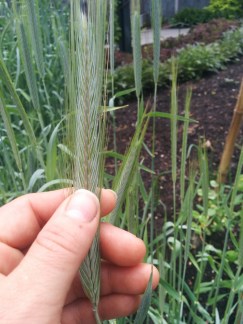
IMG_20150519_133253

Rye, Brooklyn Botanic Gardens 2015

popularity- it’s not too much of a stretch to imagine seeking out and supporting the farmers and suppliers who are making their own efforts to be good stewards of the land.

We can all be looking at where our food comes from, and how to reward the practices that encourage sustainability for more than just the reason that it is good for the environment. Healthy soil grows healthy food grows healthy people. Ideally.

Don’t Panic! Help is coming.

It feels like information about what is going wrong is all that’s out there. It may be less sensational to hear that there is positive news, but that doesn’t mean that it doesn’t exist. People from many fields are already working towards solutions and implementing them. There are also small things that each of us can do in our everyday lives towards improving our carbon footprint, regardless of who we are or what we do for a living.  You don’t have to be a scientist to reduce your own personal impact on the environment.  And there are solutions that the restaurant industry can encourage and address from within our businesses and communities. I am no longer quite so fearful, and while the anxiety still lingers; I feel a renewed sense of hope. I endeavor to seek out more people who are working on these issues and to share their efforts.

More Love,

Amanda

The Induction of “Why” into my Recipe Writing.

I didn’t become the cook that I am today over night.  A lot of experiences have helped to shape where I am today.  I learned as much, if not more, from the bad as the good.

The first years of cooking for me consisted mostly of absorbing recipes and techniques as fast as possible.  I went from zero kitchen experience to a master of my domain. I pushed myself to learn everything I could and then wanted more.  In that time, it was about the basics.  A lot of how to do something or when to do something.  In the second kitchen I entered, it was more of the same, but intensely.  An even higher pressure Michelin driven environment that taught me more precise and complicated techniques.  These first handful of years created a baseline of knowledge.  I worked for stable companies that had their systems down and their ideas in place.  I didn’t create my own things.  I created within the parameters required of the restaurant’s standards. It wasn’t until I took my first job leading a pastry program solo that I started to develop recipes that were mine.   I had to create a set of questions for myself that would help form a recipe.

Now, for me, asking myself these questions while I work on a dish is an exercise. I’ve learned that it helps my process.  And not everyone will work this way.  When I started, those questions looked like the following:

What’s in season? What do I like?  What do I know how to do well? What do I want to learn how to do? What would I like to learn how to do better?  How do I make it look good? Taste good?

As I worked, and developed my own style, more questions arose:

How do I make the dish balanced? Do I have the tools I need to make this possible? If I don’t, what tools can I use to make it possible? Or, should I rethink the execution? For example, if I wanted to make lemon meringue pie, but pie tins weren’t around- could I make a lemon meringue parfait in a jar and have it be just as delicious?  What savory or unexpected element could I add to make this dish special? So it’s not just a lemon meringue pie like all of the others.  Even in pastry, I thought: There should be balance. Sweet, salt, bitter, umami, etc. Should there be variations in texture? How does this work in terms of service? Can it be executed with this precision by others, multiple times a night? Can we take something humble and make it something spectacular? Does it have to be sweet to be dessert?

Do you notice, that all of these questions are “how’s” and “what’s”?

Most of these questions boil down to two:

1. What do you want to make?

2. How are you going to make it?  

In recent years, I have found that “why” has snuck in more and more often to my recipe process.

Why is x ingredient important? Why is it important that it be : (complicated/different or simple/approachable etc)? Are all of the steps that we put into it something that makes enough of an impact to be valued against the cost of making it?  Who is going to experience that value? Is it the chef, the line cook, the guest? Is there going to be a lot of waste in this dish? Why? Is there something we can plan to do with the waste so it is no longer wasteful?

I ask myself questions about the balance of artistry vs. labor.  What kind of an impact that labor has on the staff.  Does this labor encourage learning and excitement, or frustration and exhaustion?  Or both? And is that okay?  Who does the artistry benefit?

3. Why are we making this? 

I like to think that as I grow as a cook, I am also growing as a leader. Thinking beyond myself and beyond creating a dish in a vacuum.   The questions that I used to ask haven’t gone away. They have developed, become more precise and refined to the kind of food I want to focus on.  There is knowledge and experience that has shaped what I ask and how I answer.   There are new questions that ask for more thoughtful answers.  To be honest- sometimes it is still important for me to take time to brainstorm a dish in a vacuum, without all of the “whys” being at the forefront of my mind. My creativity is a skill, like a muscle that must be used and challenged in order to stay strong.  I like to think that asking myself “Why” can only add to the challenge and to the balance of the kind of cook that I want to be.

Finally, I want to mention the question I constantly ask about a dish before I put it in front of a guest : Is it delicious? It seems pretty obvious, but just take a step back from all of the thinking and planning and sit down at a table like a real person and eat the dish. Not just a bite. Is it delicious? Is it enjoyable? Would you want to eat it again?

I hope that I can answer some of your questions.  I hope that by sharing my experiences, that I can help to enrich yours. I hope your recipe brainstorming time is fruitful, challenging, and creates joy.

Much love,

Amanda

So we’re a little broken, let’s talk about how to change.

Over the past couple of years I have found myself having very similar conversations with a lot of my colleagues.  We’ve been talking about an industry that’s struggling.  An industry that grew so popular and so fast that now we are hitting some painful growth realities.   There are suddenly a lot of amazing restaurants- with no one to cook in them.  There are cooks, servers, managers, chefs, all working towards the hospitality of others; while they themselves work in an inhospitable environment.  There are staff who work incredibly physically demanding and sometimes dangerous jobs without proper healthcare.  There is a culture of abuse that only the strong are meant to survive, while we take a backwards sense of pride in the fact that this isn’t real living, this isn’t thriving.    Why should it be?  What kind of person can thrive under the abuse of their environment?   So the conversations continue. And we talk about the sustainability of our resources, the produce, the Earth’s environment, the guest.

There have been a lot of articles written about the ups and downs of the restaurant industry.  The New York TimesGrubstreetThrillistEaterFortune, etc. have all posted articles centered around the shortage of cooks.  The difficulty of keeping staff.  Why is that do you think?  Anything to do with the way we treat each other?

I don’t think there is one cut and dry problem or solution. It’s a complicated, multifaceted struggle that we are seeing happen in front of us. That we are talking about, at least.

The struggle is real.  We’re aware.

So where do I fall in this?   I find myself passionately involved in the conversation about sustainability- I agree that our resources are running scarce and that we should be concerned and start thinking about ways to cook in a way that is more responsible.   But I also find myself steering the conversation towards the idea that our staff and our environments that we work and live in are just as important a resource.   The sustainability of the restaurant as a whole is where my big picture keeps circling back to.

I’ve been lucky enough in my ten years in this industry to work with a lot of amazing people. I have learned that a place where we can collaborate and trust each other is the place that I truly feel fulfilled. The place where I know that the guy next to me- yes it is more likely that person is male- but that’s a different conversation. Anyways, if I know the guy next to me has my back when I need it and he knows that I can step up when he needs it, that’s the place I want to wake up and go to work in, every day. Shit pay or not. That community of people that cares and trusts each other is where I want to be.

I have also worked in a lot of places where there is a culture of fear, of abuse, of micro management and just plain bad or under developed leadership.   The idea that “it’s not personal” that you get yelled at or beat down is normal and expected.   That’s not where I want to be at all. And the idea that I am just going to move from job to job until I find a place where I can be fulfilled isn’t enough for me anymore.   I’ve seen too many places where this “social norm” is the reality.  It’s not where I want to be, it’s not where I want my colleagues to be.  It’s not what I would wish for my friends. Whether they are the guy yelling or getting yelled at.  That’s not thriving. That’s not sustainable.  Who wants to be scared and/or mad all of the time?

So here I am, trying to continue this conversation. Trying to do whatever I can to help fix what we’ve all at least started to acknowledge is broken.   Taking a stand for myself and my friends, because I can’t just keep trying to find something good for myself and watch the status quo remain the same for everyone else around me.   Let’s talk about it. About how to make our restaurants places where we all want to be. Where we can thrive.